
Falmouth’s history is really the history of its harbour. Everything from the castle on the headland to the reason there are palm trees on the seafront traces back to the water and what it made possible.
The Town & Its Name
Where is Falmouth located in Cornwall?
Falmouth sits on the south Cornwall coast, at the mouth of the Fal Estuary, a short distance from Truro and Penryn.
Is Falmouth an island?
No, Falmouth is a town on the mainland, though its position on a headland surrounded by the sea and the Fal Estuary gives it that surrounded-by-water feel that leads people to ask.
How did Falmouth get its name?
The name comes from its position at the mouth of the River Fal, straightforwardly “Fal” plus “mouth.
What was Falmouth originally called?
Before Falmouth existed as a planned town, the site was home to a small, older settlement rather than anything called Falmouth. It wasn’t until Sir John Killigrew developed the area around the harbour in the early 1600s that the town took the name and shape it has today.
Who founded the town of Falmouth?
Sir John Killigrew founded Falmouth in 1613, developing the town around the harbour that would go on to define it. Arwenack House, his family home, still stands and is thought to be the oldest building in Falmouth.
The Harbour
Why is Falmouth’s harbor famous?
Falmouth Harbour, together with the Carrick Roads estuary, is the third largest natural harbour in the world and the deepest in Western Europe, reaching depths of up to 34 metres. It’s also been the start and finish point for major round-the-world sailing records, including Robin Knox-Johnston’s first solo non-stop circumnavigation in 1969.
Is Falmouth harbor the deepest in the world?
Not quite the deepest in the world, but the deepest in Western Europe, and the third largest natural harbour globally. Only Sydney Harbour and the Port of Mahon in Menorca rank above it.
What is the history of the Falmouth packet ships?
From 1688, Falmouth became home to the Post Office Packet Service, carrying mail, passengers, and news between Britain and the Americas, the West Indies, and beyond. The town held a monopoly on this trade for around 150 years, which shaped much of its Georgian-era wealth and character.
Did Charles Darwin visit Falmouth?
Yes, and it’s one of the town’s best stories. HMS Beagle anchored at Falmouth on 2 October 1836, marking the end of Darwin’s nearly five-year voyage around the world, the same voyage that shaped the ideas behind his theory of evolution.
Pendennis Castle
Who built Pendennis Castle?
Henry VIII, as part of a chain of coastal defences built to protect England from invasion during his reign.
Why was Pendennis Castle built?
To defend the entrance to the Carrick Roads and Falmouth Harbour, working alongside St Mawes Castle on the opposite bank to cover the estuary from both sides.
When was Pendennis Castle built?
Construction began around 1540, and the castle remained in active military use for centuries afterward, right through both World Wars.
D-Day, Palm Trees & Jacob’s Ladder
What role did Falmouth play in D-Day?
A significant one. Around 27,000 American troops gathered in and around the Fal Estuary ahead of the Normandy landings, with embarkation points at Tolverne, Turnaware, Trebah, and Falmouth Docks. General Eisenhower himself stayed at Tolverne Cottage during preparations. Commemorative plaques mark several of these sites today.
Why are there palm trees in Falmouth?
Falmouth’s coastal position and the influence of the Gulf Stream give it an unusually mild microclimate for the UK, mild enough to support palms and other subtropical planting that wouldn’t survive further inland.
How many steps are on Jacob’s Ladder?
111 steps. The stairway was built by local businessman Jacob Hamblen to connect his properties, and it remains a genuine local landmark, and a proper leg workout, in the centre of town today.
Guides

The Ultimate Falmouth Guide: 110+ Questions Answered

Living in Falmouth

Student Life at Falmouth University

Events & Festivals in Falmouth

Where to Stay in Falmouth

How to Get to Falmouth

Food & Drink in Falmouth

Things to Do in Falmouth

Beaches, Gardens & Outdoors in Falmouth
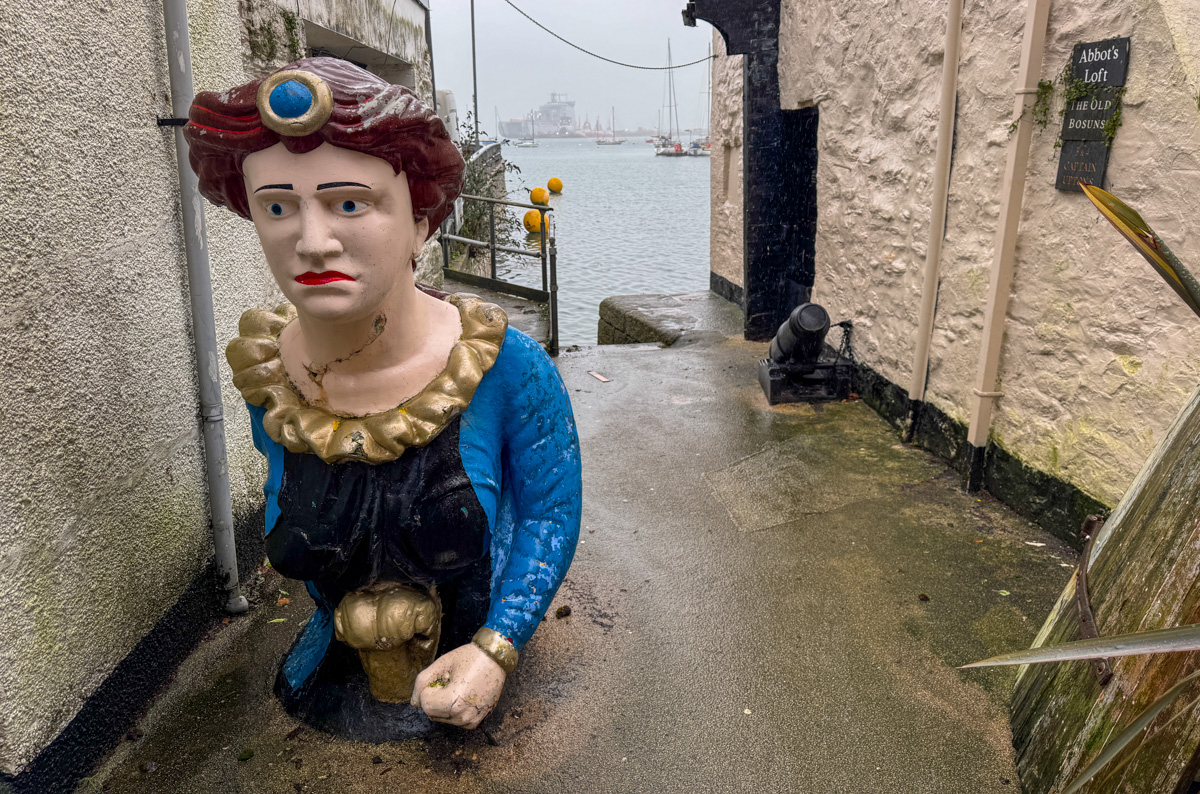
The History of Falmouth
Hi, I’m JV. As an ex travel photographer, I’ve been all over the world, but there’s nowhere else I’d rather call home than Cornwall. Now I’m putting that experience to work, finding the best of Cornwall for you. I hope you found this article useful. Please check out my socials below: